Artemis Bodrum · Jul 16, 2026 · 6 min read · Travel Guide
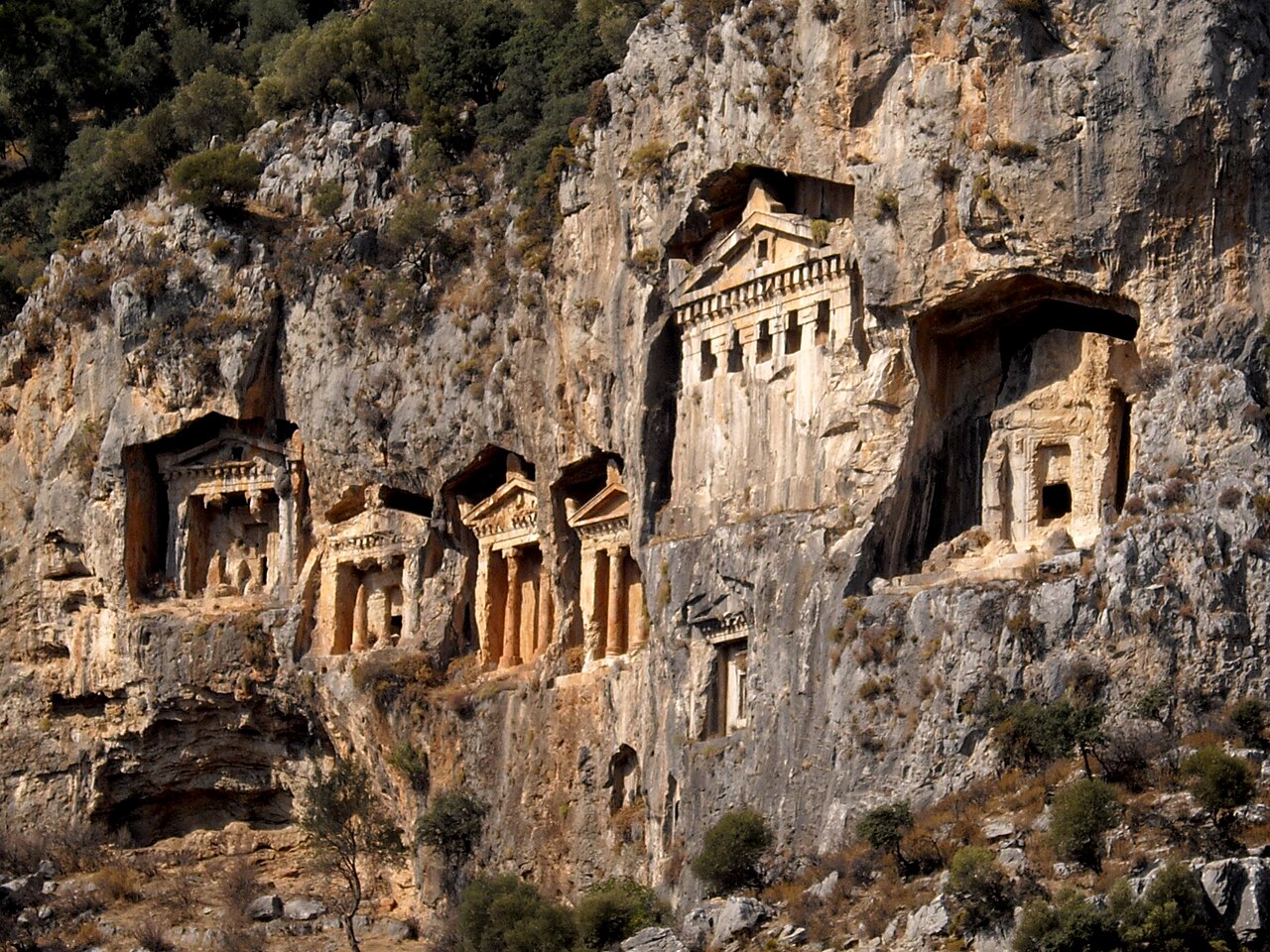
People who have seen Dalyan tend to describe the same image: a green channel winding through the reeds, a boat easing along it, and on the far slope — tombs cut into the living rock with temple façades. That view is no accident. Dalyan is one of those rare places where three separate stories are stacked onto the same five kilometres: an ancient harbour city, a turtle beach, and an environmental fight.
Kaunos: a port on the Carian–Lycian frontier
A few kilometres west of Dalyan, Kaunos was a harbour city built where ancient Caria met Lycia. Ancient writers noted that the Kaunians' language and customs differed from those of their neighbours — the place has always carried a certain in-betweenness.
Kaunos enters the historical record around 546 BC, when the Persian general Harpagus marched against the Lycians, Carians and Kaunians. It joined the Ionian Revolt of 499–494 BC. Its golden age came under the Carian satrap Mausolus (377–353 BC): the city was enlarged, reshaped with terraces, and enclosed by walls running over a huge area. The striking walls still standing today, built of regular rectangular blocks, date from this period. Remember that the same Mausolus gave the world the word "mausoleum" through his tomb at Halicarnassus, and the link between Bodrum and Dalyan suddenly feels very close.
Under Rome the city prospered again: baths and a palaestra were built and the theatre enlarged. Christianised early, Kaunos became a bishopric. Its end came from two enemies: silt and malaria. Alluvium carried down by the Dalyan river choked the harbour and cut the city off from the sea, while malaria spread through the marshland that replaced it. Kaunos was gradually abandoned and buried under sand.
What to see at Kaunos
- The rock-cut tombs (the "King's Tombs"): those façades on the far bank that everyone photographs. Dated to roughly the 4th century BC, they imitate Hellenistic temple fronts: two Ionic columns, a triangular pediment, reliefs above. They were cut for the city's leading families. One of the upper tombs was never finished — you can still see the exact moment the masons stopped work.
- The theatre: about 75 m in diameter with room for some 5,000 spectators. From the topmost rows the delta, the channel and İztuzu all sit in a single frame — the best view on the site.
- The acropolis: a rock 152 m high, fortified with Byzantine walls.
- The harbour and Sülüklü Göl: the inner port survives as the still water now called Sülüklü Göl, the Lake of the Leeches. In antiquity its mouth could be closed with a chain.
- Roman baths, the agora and church remains.
Excavations at Kaunos were begun in 1966 by Prof. Baki Öğün and later continued under Prof. Cengiz Işık. The site's greatest gift to scholarship is the bilingual Carian–Greek inscription found in 1996, which played a decisive role in finally deciphering the Carian alphabet.
İztuzu: the story of a beach that was saved
At the tip of the delta Kaunos was buried by runs a thin 4.5-kilometre ribbon of sand separating the sea from the Dalyan river: İztuzu Beach. Salt water on one side, fresh on the other — which is why it is also known as Turtle Beach.
İztuzu is one of the Mediterranean's most important nesting grounds for the loggerhead sea turtle (Caretta caretta), with an average of around 300 nests recorded here each year. But this beach is remarkable not simply for existing — it is remarkable for having survived. In 1987 construction began on a large hotel (the Kaunos Beach Hotel) right at its edge. The campaign against it drew international attention, and its emblematic figure was June Haimoff, the British woman living on the beach whom Dalyan knows as "Captain June". The campaign worked: in 1988 the Turkish government placed the area under protection and İztuzu became part of the Köyceğiz–Dalyan Special Environmental Protection Area. The construction was halted. There is not a single hotel on the beach today — and that is the result of a fight, not an accident.
DEKAMER, the Sea Turtle Research, Rescue and Rehabilitation Centre, was founded in 2008 and has operated at the beach since 2009, treating injured turtles, returning them to the sea and monitoring nests.
İztuzu's rules — please take them seriously
- The beach closes at night. Through the nesting season (roughly 1 May – 31 October) it is closed to the public between 20:00 and 08:00. This is not a suggestion; it is an enforced prohibition.
- No parasols or sunbeds in marked nesting zones. A parasol spike goes straight through the eggs. Lying on a towel in those zones is also prohibited.
- Do not dig holes in the sand. Every hole is a lethal trap for hatchlings trying to reach the water.
- No lights. Hatchlings navigate by the moon's reflection on the sea; a torch or a phone flash turns them back towards the land.
- Nesting generally begins in May and runs to mid-August; hatchlings emerge from early July into October.
Its UNESCO status: a candidate, not yet World Heritage
This is frequently reported wrongly, so to be clear: Kaunos is not on the UNESCO World Heritage List. It was entered on the UNESCO World Heritage Tentative List by Türkiye in 2014 under reference 5906 — that is, declared an official candidate. Being on a tentative list is the first step of a nomination process, not an inscription.
Practical visiting notes
- Time needed: 1.5–2 hours for the Kaunos site, half a day at İztuzu. The two combine comfortably into one day.
- Best time of day: go up to Kaunos early — there is no shade on the acropolis slope. İztuzu is at its best from mid-afternoon (remembering you must leave by 20:00).
- Getting around: Kaunos is reached by rowing boat across the river from Dalyan's waterfront, then a short walk. The rock tombs are best seen from the opposite bank or from directly beneath them on a boat tour. İztuzu can be reached from Dalyan by road (minibus) or by boat down the channel — the boat wins on scenery by a wide margin.
- Hours and fees: the Kaunos site is generally open 08:30–19:00 in summer and 08:30–17:30 in winter, and the Turkish Museum Pass is valid. Rates change annually, so confirm on the Ministry's official page, and be prepared for the kiosk to want cash.
- Bring: water, a hat, closed shoes. The site is steep and stony.
Getting there from Bodrum
Dalyan lies roughly 180 km from Artemis Bodrum, about 2.5–3 hours by car via Bodrum – Milas – Muğla – Köyceğiz – Ortaca; after Ortaca, follow the signs for Dalyan. Given the distance, plan Dalyan as a long day with an early start, or consider staying a night.
What else is nearby
The same route takes in Lake Köyceğiz and the Sultaniye hot springs (a standard stop on the Dalyan boat tour), the town of Ortaca, and, a little further east, the bays of Göcek. Routing your return via Köyceğiz gives you a break on the lakeshore.
For location, distance and access details, see our Dalyan, Kaunos & İztuzu destination page. Our reception team is happy to help you shape the day.
Sources
- Kapak görseli: Kaunos Kral Mezarları, Dalyan — Rev Stan (Wikimedia Commons)
- UNESCO Dünya Mirası Merkezi — Geçici Liste: Kaunos (Ref. 5906, 2014)
- Bilgi kaynağı: Wikipedia — Caunus (Kaunos)
- Bilgi kaynağı: Vikipedi — İztuzu Plajı (koruma statüsü, yuvalama, Kaptan June, DEKAMER)
- Ziyaret bilgileri: T.C. Kültür ve Turizm Bakanlığı — Kaunos Örenyeri
 Artemis Bodrum