Artemis Bodrum · Jul 16, 2026 · 4 min read · Travel Guide
Most ancient cities grew by accident. They clung to a hill, spread around a harbour, and their streets followed what had once been goat paths. Priene is the exception. Priene was designed on paper first and then laid onto the land. That is why archaeologists so often call it the textbook of ancient urban planning — and they are not exaggerating.
A designed city on the slope of Mount Mykale
Priene sits on terraces cut into the steep flank of Mount Mykale, in what is today the village of Güllübahçe in the Söke district of Aydın. Settlement here is far older, but the city you walk through today was rebuilt from scratch in the mid-4th century BC. The earlier Priene had been a harbour town, but the alluvium carried down by the Great Meander kept pushing the coastline outward, forcing the city to relocate more than once.
The new city was laid out on the grid plan associated with the architect Hippodamus: streets meeting at right angles, insulae of equal size, and public buildings whose positions were fixed in advance. Six main east–west avenues (roughly 6 m wide) are crossed by some fifteen north–south streets (roughly 3 m), dividing the city into around eighty blocks. The remarkable part is that this rigid order was imposed not on a flat plain but on a punishingly steep slope — which is why several of the north–south "streets" are in fact stairways.
An estimated 4,000–5,000 people lived here at any one time. Roughly one house in three had an indoor toilet, an unusual comfort for the period. Spring water from Mykale was carried by aqueduct into cisterns and distributed to the houses through clay pipes.
What not to miss
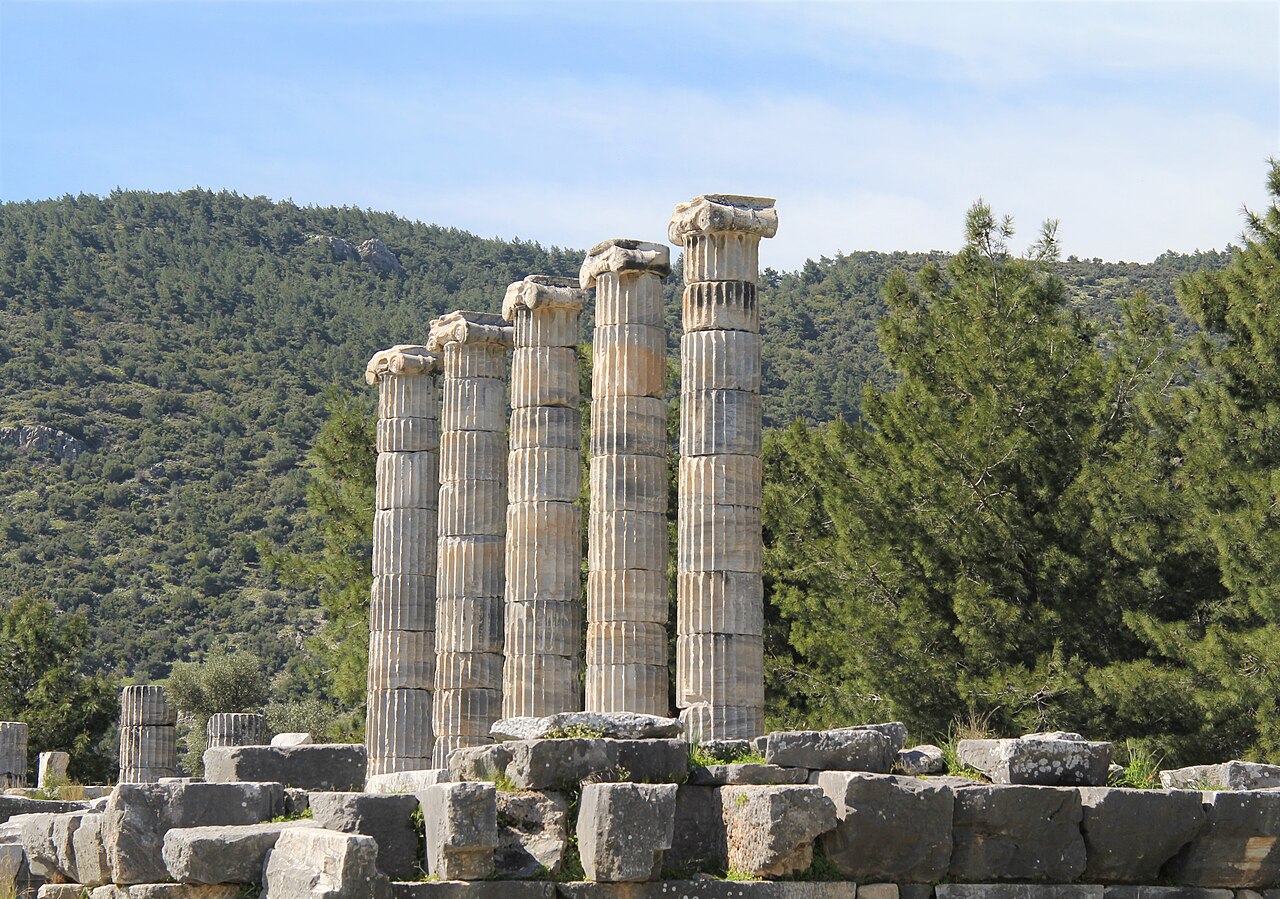
- Temple of Athena Polias: the emblem of the site, its slender Ionic columns rising among the pines. Its architect was Pytheos, the same man behind the Mausoleum at Halicarnassus in Bodrum — a direct architectural kinship between the two cities. The dedicatory inscription reads that "King Alexander dedicated the temple to Athena Polias"; it is now in the British Museum. The temple was dedicated in 323 BC.
- The theatre: one of the best-preserved Hellenistic theatres anywhere. The lion-footed prohedria — the front-row seats of honour — still stand exactly where they were placed.
- The bouleuterion: the council chamber north of the agora, a small stepped hall once roofed in timber. Priene was a democracy in the 4th century BC, and this is where its decisions were made.
- Agora, gymnasion and stadium: the walls of the lower gymnasion still carry names scratched into them by its students.
- Sanctuaries: separate precincts for Demeter, Asclepius and the Egyptian gods (Isis, Serapis, Anubis), plus the remains of a synagogue with a carved menorah.
Its UNESCO status: a candidate, not yet World Heritage
This distinction is worth stating plainly, because it is frequently muddled. Priene is not on the UNESCO World Heritage List. It was entered on the UNESCO World Heritage Tentative List by Türkiye on 5 February 2018, under reference 6348, as the "Archaeological Site of Priene". A tentative list is a state's declaration of sites it intends to nominate in the future — so Priene is an official candidate, not an inscribed World Heritage property. The case for it rests on exactly what is described above: a rare, intact example of Hellenistic city planning.
Practical visiting notes
- Time needed: allow 2 to 2.5 hours, including the climb.
- Best time of day: 09:00–11:00 or late afternoon. The city faces south on a bare slope, and there is almost no shade at midday in summer.
- Footwear: proper trainers or hiking shoes, not negotiable. The ancient marble steps are slippery.
- Hours and fees: the site is generally open 08:30–19:00 in summer and 08:30–17:00 in winter. The Turkish Museum Pass is valid for Turkish citizens. Ticket prices are revised annually, so please confirm current rates on the Ministry of Culture and Tourism's official page.
- Bring: water, a hat, sunscreen. There is no kiosk inside the site.
Getting there from Bodrum
Priene lies roughly 120 km from Artemis Bodrum, about 2 hours by car via Bodrum – Milas – Söke; after Söke, simply follow the signs for Güllübahçe. There is parking at the entrance. By public transport, take a coach from Bodrum to Söke and a minibus from Söke to Güllübahçe — but check return times in advance.
Combine it in one day
Priene is rarely visited alone. The classic regional route is the "three ancient cities": Priene, Miletus and Didyma, all strung along the same coastline the Meander silted up. Miletus is about 25 km away, and the colossal Temple of Apollo at Didyma a little further south. An early start lets you do all three and be back in Bodrum by evening. Route yourself past Lake Bafa and you will also see what became of the Latmian Gulf, which was once open sea.
For location, distance and access details, see our Priene Ancient City destination page. Our reception team is always glad to help you plan a day trip into the region.
 Artemis Bodrum