Artemis Bodrum · Jul 16, 2026 · 6 min read · Travel Guide
Some places are famous for one thing. Patara has at least three: the parliament house of one of the earliest known democratic federations, a Roman lighthouse re-erected two thousand years later, and roughly 18 kilometres of undeveloped sand stretching out behind it. All of it sits inside the same dune system, within walking distance of itself.
The Capital of Lycia
Patara was the capital of the Lycian League and the region's principal harbour. The League united some 23 cities and is regarded as one of the first known democratic federations: voting power scaled with a city's size, and the largest members — Patara, Tlos, Pinara, Xanthos, Myra and Olympos — each held the maximum of three votes.
Patara was also an oracle city: the sanctuary of Apollo here was said to rival Delphi in the ancient world. Its harbour was a major node of Mediterranean trade — until silt and sand swallowed it. Which is precisely why Patara survives so well today: the sand buried the city and, in burying it, kept it.
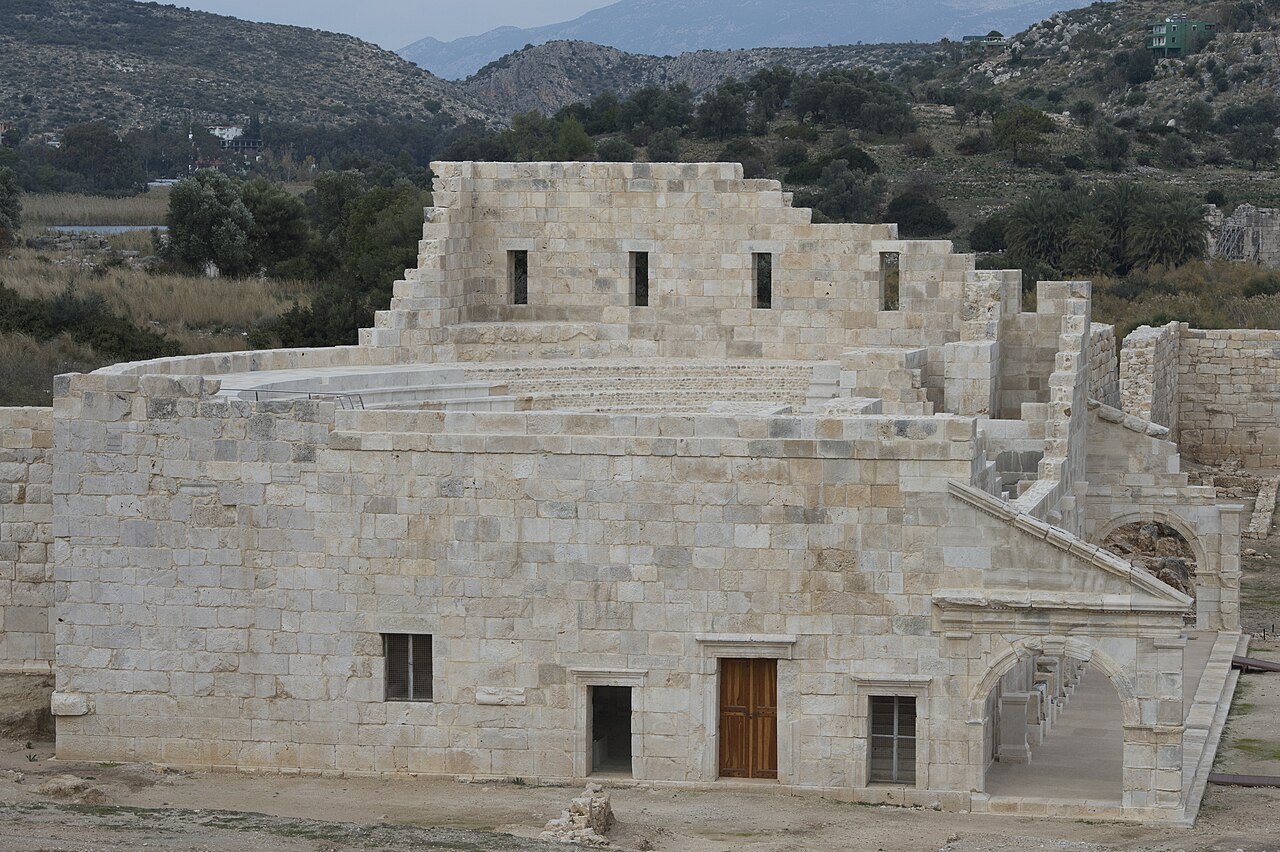
The Bouleuterion
Standing behind the west stoa of the central agora, the Assembly Hall of the Lycian League is the heart of Patara. Excavation established that its seating tiers could hold roughly 1,400–1,500 people. Between 2008 and 2012 the building underwent a comprehensive conservation and restoration programme supported by the Grand National Assembly of Turkey, carried out by the excavation team under Prof. Dr. Havva İşkan Işık, and it opened to visitors in May 2012.
Step inside and it takes a moment to register that these tiers were not a theatre but a decision-making machine — a chamber where delegates from different cities voted in proportion to their size. Federal representation, rendered in stone.
The Lighthouse: Standing Again After 2,000 Years
Patara's most striking story belongs to its lighthouse. Monumental inscriptions on the structure record that it was built in AD 64/65 by the emperor Nero for the safety of sailors and sea travellers — making it one of the oldest known lighthouses in the world. It stood roughly 26 metres tall and served for centuries; it is understood to have been destroyed in the 15th century, by the tsunami triggered by the 1481 Rhodes earthquake.
What followed is one of archaeology's rarer victories. Excavations in 2004–2005, beneath an enormous dune, recovered hundreds of the lighthouse's original stone blocks. Each was treated at a facility nicknamed the "stone hospital", and a restoration begun in 2020 ran for about five years until the tower was re-erected from its own original stones. What you see today is not a replica — it is a Roman building standing on its own masonry again.
Saint Nicholas, and the Rest of the City
By long-standing tradition, Saint Nicholas — the figure who would eventually become Santa Claus — was born at Patara around AD 270, later serving as bishop at Myra (modern Demre). In fairness, this rests on church tradition rather than on any archaeological find, and we'd rather say so plainly.
You'll also find:
- The Arch of Modestus: The monumental gate at the northern entrance, which doubled as part of the city's aqueduct.
- The theatre: Largely cleared of sand and rising dramatically out of the dunes.
- The main colonnaded street and harbour: Running down toward a port the sea has long since abandoned.
- The Stadiasmus Patarensis: A monumental inscription found in 1993 listing the Roman road network and its distances — one of the key documents of Anatolian road history.
Systematic excavation at Patara has continued since 1988.
UNESCO: Candidate, Not World Heritage
Patara — with Tlos, Pinara, Myra and Olympos — was added in 2009 to the UNESCO World Heritage Tentative List under the serial file "Ancient Cities of Lycian Civilization" (ref. 5408). So Patara is an official candidate, not an inscribed World Heritage site. Nearby Xanthos-Letoon, on the other hand, genuinely has been on the World Heritage List since 1988 (ref. 484). Keeping the two straight is both accurate and, frankly, respectful to the candidate cities.
Patara Beach and the Loggerhead Rules
Walk past the ruins and a dune-backed beach opens up and runs, unbroken, for some 18 kilometres. No hotels, no concrete — because this is a Special Environmental Protection Area and a nesting beach for loggerhead turtles (Caretta caretta).
The rules are real and enforced:
- The beach is open 08:00–20:00; entry is prohibited between 20:00 and 08:00 to protect the turtles.
- The night ban applies during nesting season, alongside other nesting beaches such as İztuzu and Çıralı; the season runs roughly from late April to October.
- No lights, no fires, no camping and no noise at night — artificial light disorients emerging hatchlings.
- Stay off the dunes and away from marked nests, and don't drag loungers outside the designated zones.
None of this exists to inconvenience visitors. It exists to keep one of the Mediterranean's most important nesting beaches alive for a declining species. Leaving the sand before sunset is the single best thing you can do for Patara.
Practical Notes
- Time needed: 2–3 hours for the ruins; a full day with the beach.
- Best timing: Ruins early in the morning (there is no shade in the dunes), beach in the afternoon, off the sand before 20:00.
- Tickets: One ticket covers both the site and the beach; the Turkish Museum Pass is valid. Fees and hours change seasonally — confirm before you go.
- Bring: A hat, sunscreen, plenty of water and shoes you can walk on sand in. Parking and toilets are available.
Getting There From Bodrum — The Honest Version
Patara is about 285 km by road from Artemis Bodrum, more than four hours of driving each way. It is the most distant stop in this guide, and we'll say it plainly: Patara is not a day trip. A return run is over eight hours behind the wheel, and squeezing the bouleuterion, the lighthouse and the beach into what's left of the day simply doesn't work.
Make Patara the finale of a two- or three-day Lycian route instead:
- Day 1: Bodrum → Fethiye; Tlos in the afternoon, overnight near Fethiye.
- Day 2: Pinara in the morning, Xanthos and Letoon in the afternoon, overnight in Kalkan or Gelemiş (Patara village).
- Day 3: Patara ruins in the morning, Patara Beach in the afternoon, then the drive back to Bodrum.
Kalkan and Kaş are very close by; if you can stretch the trip one more night, doing so more than pays back the drive.
Other Stops Nearby
- Xanthos and Letoon: The nearest inscribed UNESCO World Heritage site.
- Pinara and Tlos: Two candidate Lycian cities in the same valley, close to each other.
- Saklıkent Gorge: Right next to Tlos — the cold break in a hot day.
- Kalkan and Kaş: The two most practical bases for dinner and a bed.
Come to Patara as the capital of Lycia rather than as a beach stop — sit on the assembly's tiers, put your hand on the lighthouse's stones, then leave the sand before the sun goes down — and those 285 kilometres are more than worth it. Our reception team at Artemis Bodrum is glad to help with the route and the overnight stops.
Sources
- UNESCO Dünya Mirası Merkezi — Ancient Cities of Lycian Civilization (Geçici Liste, ref. 5408, 2009)
- Patara Kazıları resmî sitesi — Deniz Feneri (MS 64/65, Nero yazıtı; 2004–2005 kazıları)
- Patara Kazıları resmî sitesi — Likya Birliği Meclis Binası
- Anadolu Ajansı — Yeniden ayağa kaldırılan Patara Deniz Feneri (restorasyon 2020–2025)
- Anadolu Ajansı — Dünyanın ilk meclis binası ziyarete açılıyor (TBMM destekli restorasyon, 2012)
- UNESCO Dünya Mirası Merkezi — Xanthos-Letoon (Kesin Liste, ref. 484, 1988)
- Kapak ve gövde görselleri: Patara — Likya Birliği Meclis Binası — Dosseman (Wikimedia Commons, CC BY-SA 4.0)
 Artemis Bodrum